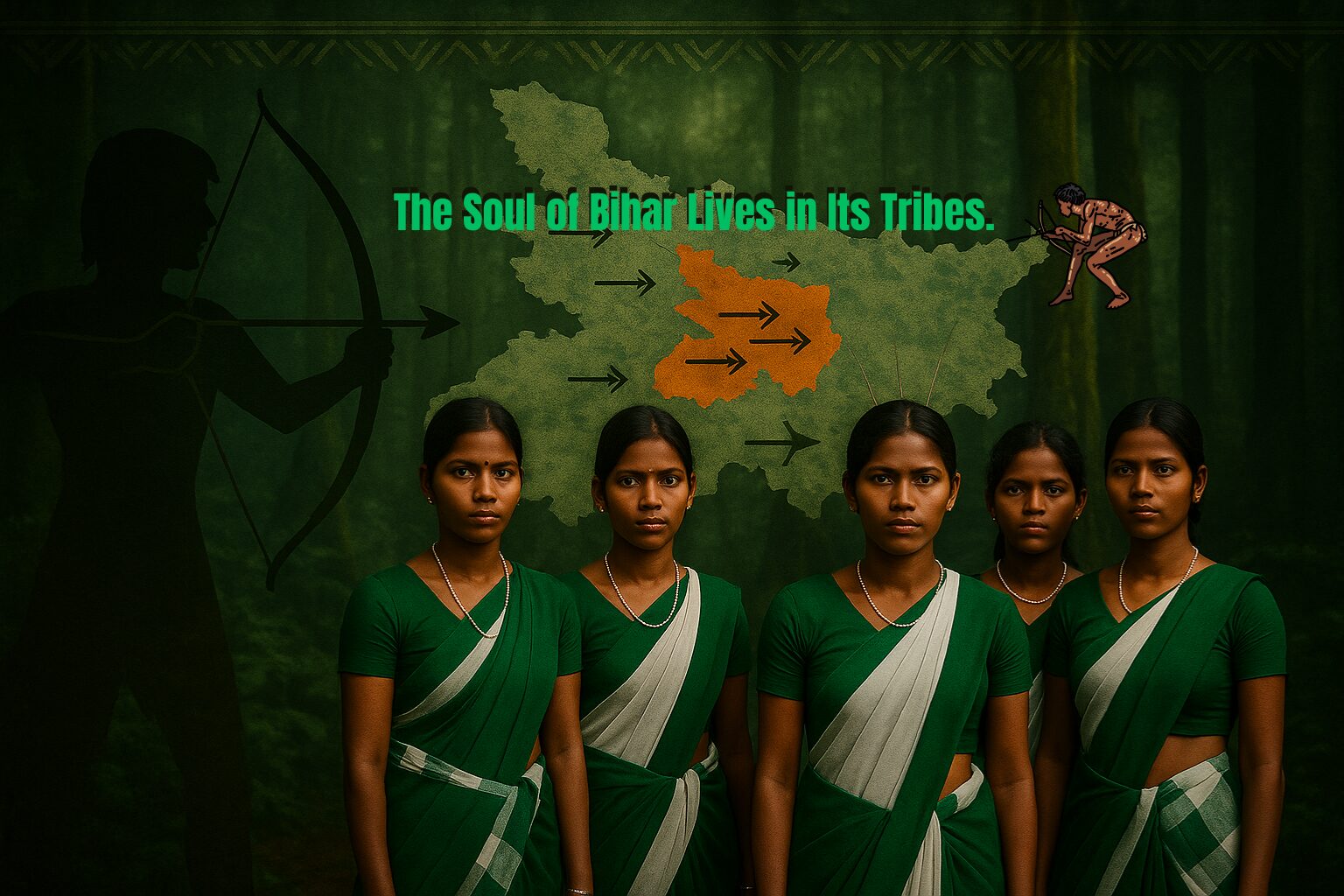
The tribes of Bihar are living examples of an ancient civilization, rich in traditions that are older than the forests, rivers, and mountains. Their stories come alive in their festivals, and their crafts show the skills passed down through generations. Their dialects express a strong sense of identity that remains vibrant. In Bihar, tribes like the Santhal, Ho, Munda, Oraon, and Kharwar have maintained a culture built on courage, struggle, and a close connection with nature.
Their folk dances are more than performances; they represent their fight for survival. Their folk songs remember their ancestors, and their religious rituals connect them to a world that modern life often overlooks. To understand these tribes is to enter a world where life follows the seasons. Each festival is a celebration of nature, and every custom tells a story of strength.
Their traditions are not fading; they are changing and growing. A unique aspect of these tribes is their deep respect for their culture and customs. This is the vibrant world of the tribes of Bihar alive, powerful, and very proud.
Introduction to Tribal Communities in Bihar Tribes of Bihar

The tribal communities of Bihar are culturally rich yet less known. Although they make up a small part of the population, they are important to the state’s history, culture, and social structure. For centuries, these tribes have lived in harmony with nature, forming a strong connection to forests, hills, rivers, and wildlife. Their beliefs, customs, and daily lives show deep respect for nature and ancestral wisdom.
Main tribal groups in Bihar include the Santhal, Oraon, Munda, Ho, Kharia, Pahari, Birhor, and Korwa, along with smaller tribes. Their culture features folk songs, musical instruments, dance, community gatherings, and seasonal festivals, contributing to a unique tribal identity.
Unfortunately, many tribes are overlooked and face issues like land loss, displacement, limited education, and unemployment. Despite these challenges, they maintain their cultural roots through nature worship, oral history, and strong community values. Understanding these communities helps us appreciate Bihar’s diverse heritage and the challenges they face.
History of Tribal Communities in Bihar (Origin & Ancestral Roots)
The tribal communities of Bihar are among the oldest people in the region. Their history goes back to the Stone Age, before organized states existed. Archaeological finds, such as cave carvings and ancient tools in Bihar and Jharkhand, show that these tribes were the first to settle in eastern India. This means they have lived there for a very long time. Scholars often connect the Santhal, Munda, Ho, Oraon, Kharia, Pahari, Birhor, and Korwa tribes to Austro-Asiatic and Dravidian ancestries.
This suggests that their ancestors moved from Southeast Asia and Central India to the forests of Bihar and Jharkhand thousands of years ago. Over time, these tribes spread through the forests and hills, living in balance with nature and developing their own dialects, customs, and governance systems. Records from the Magadha and Anga empires around 600 BCE mention tribes called Nishads, Kirats, Kols, and Mundas. These tribes played important roles as hunters, warriors, farmers, and guardians of the forest.
They are linked to neighboring tribes in Jharkhand, Odisha, Chhattisgarh, Madhya Pradesh, and West Bengal, creating a continuous culture in eastern India. A key moment in their history happened during the British colonial period. Land dispossession, forest restrictions, and mining pushed the tribes away from their homes.
This exploitation led to many tribal resistance movements, many of which are not recorded in mainstream history. This shows the struggle to recognize and preserve tribal histories. Today, despite numerous challenges, the tribes of Bihar continue to protect their ancient identity. They maintain their worship traditions, nature-based spirituality, and storytelling, preserving their original cultural roots.
Tribal Population & Demographic Facts
Bihar has around 1.3 to 1.4 million Scheduled Tribe (ST) members, which is about 1% to 1.5% of the state’s total population. This makes them one of the most underrepresented tribal groups in India.
Most tribal communities live in the districts of Purnia, Katihar, Kishanganj, Bhagalpur, Munger, Jamui, Banka, Gaya, Nawada, Rohtas, Kaimur, Aurangabad, Lakhisarai, and surrounding areas.
Many live in forests, hilly areas, and remote villages, which makes it hard for them to access modern education, healthcare, infrastructure, and job opportunities. Some groups, like the Birhor, Mal Pahari, and Korwa, are especially vulnerable. They face challenges in preserving their culture, securing their livelihoods, and maintaining their identity.
Bihar Tribes List (Recognized Tribal Groups)
There are 32 officially recognized Scheduled Tribes in Bihar. Among them, some are large and widely known, while others remain lesser-known and culturally unique.
Major Tribal Communities of Bihar include:
- Santhal
- Oraon
- Munda
- Ho
- Kharia
- Lohra
- Bhumij
- Kharwar
- Gond
- Baiga
- Birhor
- Korwa
- Mal Paharia
- Sauria Paharia
- Bedia
- Parhaiya
- Chik Baraik
- Kisan
- Mahli
- Asur
- Khond
- Savar / Saonr
- Bhuiya
- Binjhia
- Chero
- Kol
- Kanwar
- Tharu
- Biyar
- Banjara
- Patar / Pardhan
This list highlights the diverse tribal heritage of Bihar, showing that beyond a few commonly known names, many small and hidden tribal communities exist whose stories rarely become visible in mainstream culture and media.
Tribal Culture, Festivals & Ritual Practices of Tribes of Bihar

The tribal culture of Bihar reflects the deep connection between people, nature, and ancestral heritage. For generations, the tribals of Bihar have maintained unique cultural traditions deeply rooted in community life, a profound respect for the environment, and spiritual values.
Their festivals, rituals, music, folk dance, and artistic expressions symbolise unity, gratitude, and the rhythm of seasonal change.
Each celebration carries deep meaning, honouring nature, harvest festivals, and ancestors. Even today, tribal communities continue to preserve their cultural identity through traditional customs that reflect the wisdom passed down through the centuries. These living traditions represent the living soul of Bihar’s indigenous heritage.
Cultural Identity and Traditional Lifestyle of Bihar’s Tribal Communities
The tribes of Bihar lead a lifestyle rooted in simplicity, community bonding, and harmony with nature. Their cultural identity is shaped by strong social values such as unity, equality, mutual support, and respect for the environment. Traditionally, tribal settlements are built around community groups known as tolas or paras, where families live close to each other and function as a collective unit. This is common among most tribals in India.
Agriculture, forest resource collection, and traditional handicrafts comprise the main sources of their livelihood. Handicrafts are traditional among the tribals. Many tribes depend on forest products such as medicinal plants, natural fibers, honey, bamboo, and wood for their daily needs. Tribal houses are usually constructed from natural materials like clay, bamboo, and straw, symbolizing sustainable living. These materials are also beneficial for health.
Elders play a vital role as guardians of cultural knowledge, guiding decisions, rituals, and conflict resolution. Storytelling, folk music, and folk dance are essential parts of their daily lives, passing down history and wisdom from one generation to the next. Their way of life conveys a powerful message: life should be connected to nature and community, not to material excess. That is why tribals believe that nature is life.
Major Tribal Festivals Celebrated in Bihar
The tribes of Bihar celebrate a variety of vibrant cultural festivals that highlight their strong ties to agriculture, culture, and spiritual beliefs. Each festival holds symbolic meaning and plays a key role in strengthening community bonds. The most significant celebrations include Sarhul, a spring festival dedicated to the worship of the sal tree, which is seen as a symbol of life and purity.
The festival marks the arrival of new leaves and the renewal of nature, celebrated with traditional drum dances, lk dances, and prayers for prosperity. All messages from nature are understood by the tribals, and decisions are made based on nature’s signals. This practice is common among all tribal communities.
Another widely celebrated festival is Karma, named after the god Karam, the deity of nature and fate. During this festival, people perform folk dances around a sacred branch, singing ancestral songs that express gratitude to nature for protecting life and crops. The Sohrai, or Bandha, festival, celebrated after the harvest, honors livestock and agricultural abundance. Houses are decorated with traditional Sohrai wall paintings made from natural pigments, and musical gatherings continue throughout the night.
Festivals like Mege Parab, Baha Parab, and Jitiya are also very important. They honor the ancestors, the cycle of seasons, and the power of community unity. Through these celebrations, tribal groups preserve their cultural identity, strengthen community bonds, and pass on values to future generations, ensuring their heritage remains alive and respected.
Bihar Tribal Lifestyle & Daily Life Culture

The tribal lifestyle of Bihar is a way of life that reflects identity, dignity, and deep cultural roots. The tribes of Bihar maintain a harmonious relationship with nature, community, and spirituality. Every day begins before sunrise, when the forest is wrapped in mist and the birds announce dawn. Life here is simple yet profoundly meaningful—guided by respect for the land, collective responsibility, and ancient wisdom passed down through generations.
If you ever get a chance, experience the breathtaking natural environment where the tribes of Bihar live in balance with the earth and the sky.
For tribal communities, the forest is a home, a school, a hospital and a temple. Work is never a burden; it is a celebration, accompanied by folk songs, drums, laughter and unity. Food comes directly from nature. Millet, forest greens, honey, bamboo shoots, mahua flowers which are cooked on earthen stoves with zero waste. The nights are lit not by electricity, but by bonfire storytelling, music and the guidance of the moon. Take advantage of eating food cooked on the stove someday.
In this culture, no one is alone. Every child belongs to the community, every elder is respected, and every problem is shared.
This is the real heartbeat of tribal life in Bihar, peaceful, resilient, spiritual, and beautiful human beings.
The Rhythm of Dawn When Life Wakes with the Forest
In the tribal villages of Bihar, mornings begin before sunrise. The forest is silent at first, but soon the cool breeze flows through the trees, leaves rustle gently, and birds sing across the sky. The first cooking fire sends warm smoke into the air, blending with the sweet fragrance of mahua flowers in bloom. Life moves slowly and peacefully, guided by nature instead of machines, reflecting how deeply the tribes of Bihar stay connected to their surroundings.
Community Before Self A Bond Stronger Than Blood
In tribal culture, no one stands alone. The entire village shares every challenge, celebration, or crisis. Whether it is birth or death, harvest or loss, the community comes together as one unified heartbeat. Decisions are made collectively under the shade of ancient trees, where elders pass down the wisdom of generations. Here, unity is not only a way of living it is a strength. The tribes of Bihar truly exemplify the real power of togetherness and community spirit.
Work as Worship The Sacred Connection to Land
For the tribal communities in Bihar, farming isn’t just a job it is a sacred connection with the land. They see the soil as a tribute to their ancestors who protected and nurtured it. Every seed they plant is like a prayer to Mother Earth, filled with hope and respect. They use their tools with care and celebrate each harvest with gratitude. Their belief is simple:
“If the land thrives, we thrive.”
This deep respect for nature helps keep their environment fertile, clean, and full of life. The tribes of Bihar continue to protect this balance with pride and responsibility.
Music, Dance & Fire Celebrations that Light Up the Forest
Music and folk dance are powerful expressions of cultural life for the tribal communities of Bihar. Although they don’t celebrate every night, during festivals, harvest seasons, and community gatherings, the rhythmic sound of drums resonates through the forest, and torches illuminate the darkness. Dance becomes a heartfelt expression of gratitude, a sharing of ancestral stories, and a symbol of unity. For them, it goes beyond entertainment; it embodies identity, serves as a prayer, and preserves cherished memories for future generations.
Despite increasing deforestation in the name of development, the tribes of Bihar continue to stand strong in protest. Their fight for jal–jungle–zameen (water, forest, and land) is ongoing, inspiring a powerful movement for justice, cultural survival, and environmental preservation.
Food from the Forest Simple, Pure, and Healing
Food is served on sal leaves and cooked over a wood-fire stove, reflecting a deep and respectful connection to nature. Their diet, rich in red rice, millet bread, mahua drink, wild honey, bamboo shoots, and herbal vegetables, shows how much they value every ingredient gathered from the forest, helping preserve its delicate balance. Nature nurtures them, and in return, they remain devoted stewards of the land. With only minimal use of oil in their meals, their lifestyle honors simplicity and purity.
However, as times change, the younger generation of the tribes of Bihar seeks to step into the modern world while still cherishing and protecting their roots.
The Soul of Survival Wisdom Older Than Time
The tribes of Bihar retain ancient knowledge of herbal medicine, bone healing, wilderness navigation, and seasonal weather patterns wisdom that the modern world is only beginning to rediscover. Generations may change, but their values remain unwavering:
Live simply. Share generously. Respect the earth.
The Educational Struggle and Rising Hope of the Tribes of Bihar
Education has become a powerful symbol of hope for the tribes of Bihar, yet their journey is filled with struggle, sacrifice, and determination. In remote forest villages, where schools are miles away and resources are limited, children continue to strive for learning with unwavering courage. Their dream is simple to rise above the challenges, protect their cultural identity, and pave the way for a brighter future.
Problems in Tribal Education
Despite education being a path to progress, the tribes of Bihar face several obstacles that make learning difficult and often inaccessible. These challenges are deeply rooted in geography, poverty, and the lack of effective support systems, which prevent many children from receiving quality education. Laws and policies exist, but their implementation remains weak often compromised by political interests rather than real change.
Major Problems in Tribal Education
Lack of Educational Infrastructure
Many tribal villages are located deep inside forests and hilly terrain, far from schools. Basic facilities such as classrooms, electricity, clean drinking water, and separate toilets for girls are often missing, leading to high dropout rates.
Shortage of Trained Teachers
Schools in tribal regions frequently operate with very few teachers. Often one teacher manages multiple classes, which affects the quality of learning. Teachers from outside the community struggle to understand tribal languages and culture.
Language Barriers
Children grow up speaking local dialects such as Santhali, Kurukh, Mundari, Ho, and Pahadia, but schools teach only in Hindi or English. This sudden shift in language creates confusion and frustration, causing many students to drop out early. Schedule V is designed to ensure that teachers are from tribal communities so that students can learn in a familiar dialect, but unfortunately, the implementation is almost nonexistent.
Poverty & Economic Pressure
Most tribal families depend on daily labour and seasonal farming. Children are required to help with household or forest work, making regular schooling difficult.
Long Distances and Unsafe Travel
Many students walk miles through forests, rivers, or hills to reach school, risking safety and exhaustion.When parents themselves have never attended school, education does not always seem like a priority.
Government Initiatives
To support education among the tribals in Bihar, the government has introduced several schemes and policies to reduce dropout rates and improve access to quality education. These initiatives aim to provide financial assistance, better infrastructure, and equal opportunities to tribal students, although progress at the ground level remains limited. Laws have been passed, but government policies are rarely implemented effectively.
Key Initiatives
- Eklavya Model Residential Schools (EMRS)
Residential schools offering free education, hostel facilities, uniforms, books, and meals for tribal students, aiming to create a strong academic foundation.
- Ashram Schools & ST Hostels
Hostels and special schools built to support children living in remote forest regions, helping them continue their studies without traveling long distances.
- Scholarship & Financial Aid Programs
Pre-matric and post-matric scholarships, free bicycles, school uniforms, and mid-day meals are provided to encourage attendance and reduce dropouts.
- Teacher Training & Local Recruitment
Policies such as Schedule V emphasize hiring teachers from tribal communities who understand local languages and culture, although practical implementation is still insufficient.
- Digital Education & Tribal Resource Centers
Efforts to introduce smart classrooms, e-learning tools, and cultural learning models have begun in selected districts.
Many laws have been made and continue to be created, but often not in the interest of the tribals, rather, in the interest of political leaders. As a result, tribal students suffer the consequences.
Endangered Tribal Communities The Fading Identity of the Tribes of Bihar

The tribal communities of Bihar have rich traditions, dialects, and cultural knowledge that have evolved over centuries. However, many of these groups are now facing the threat of extinction. Factors such as modern development, displacement, deforestation, and the loss of traditional livelihoods have left some communities voiceless. Their populations are rapidly declining, and their unique identities are disappearing from both society and history.
If these voices disappear, we will lose an irreplaceable legacy forever.
Tribes That Are Near Extinction in Bihar
Pahadia Tribe
Once known as fearless forest guards and skilled hunters, the hill tribe is now struggling for survival due to displacement from the forests, poverty and lack of government recognition. Their dialect, dress code and religious customs are disappearing as the younger generations move towards urban life for survival.
Birjia Tribe
The Birjia are among the smallest tribal groups in the region. With limited access to land, food security, and education, their population is shrinking. Many live below the poverty line with minimal support systems.
Asur Tribe
Known historically for ancient iron-smelting skills, the Asur tribe is losing its cultural identity rapidly. Modern mining and industrialization have destroyed their traditional occupations, pushing them toward extinction.
Sabar Tribe
The Sabar community, once forest gatherers and traditional healers, now faces extreme marginalization. Their cultural practices and language are dying out due to forced modernization and social neglect.
Bihnor Tribe
The Bihnor tribe is one of the lesser-known indigenous communities of Bihar, now standing on the edge of extinction. Traditionally forest dwellers and skilled gatherers, the Bihnor people have lost most of their land and livelihood due to rapid deforestation and displacement. Their population has fallen sharply in the past few decades, and their dialect and cultural practices are barely being passed to the next generation. Lack of government recognition and support has pushed them into silence, making their survival uncertain.
These tribes do not understand the manipulative games of worldly politics; nor are they influenced by power or greed. They rely solely on their culture, values, and the teachings passed down by their ancestors. For the tribes of Bihar, their identity is rooted in honesty, simplicity, and respect for nature. While the modern world races toward materialism, they continue to protect their heritage with quiet strength, living a life guided not by politics, but by tradition and truth.
Why Are These Tribes Disappearing?
- Loss of forest land and displacement
- Poverty and lack of education
- Forced relocation for development projects
- Loss of traditional occupation
- Neglect in government policies
- Social discrimination & isolation
- Cultural erosion due to modernization
FAQ
How many tribes are there in Bihar?
Bihar is home to several officially recognized tribal communities, including the Santhal, Oraon, Munda, Ho, Kharia, Gond, Pahadia, Birjia, Asur, Sabar, and Bihnor. Each community has its own unique culture, dialect, and traditional identity.
Which are the major tribes of Bihar?
The major tribes of Bihar include Santhal, Oraon, Munda, Ho, and Pahadia. These communities form a significant part of Bihar’s tribal population and preserve strong cultural traditions.
Which tribes of Bihar are facing the threat of extinction?
Tribal groups such as the Pahadia, Birjia, Asur, Sabar, and Bihnor tribes are currently at risk due to displacement, deforestation, and the loss of traditional livelihoods. These endangered communities represent the disappearing identity of the tribes of Bihar, who now stand on the edge of extinction.
What steps is the government taking to support tribal education?
Initiatives such as Eklavya Model Residential Schools (EMRS), scholarships, Ashram schools, mid-day meals, and hostel facilities aim to improve education for tribal children. However, implementation remains weak.
What is the traditional lifestyle of the tribes of Bihar?
Their lifestyle is deeply connected to nature, community living, herbal healing, forest-based food, and cultural festivals. The tribes of Bihar follow a simple yet powerful principle:
Conclusion
The tribes of Bihar are not just communities; they are a living legacy of centuries-old wisdom, culture, and a deep respect for nature. Their stories teach us what it truly means to live in harmony with nature, not to dominate it, but to protect it like a family. Yet today, many tribal communities stand at a crossroads, fighting displacement, invisibility, and neglect.
If we remain silent, we risk losing the voices that once shaped the very core of India’s cultural identity. Protecting them is not a charity – it is a responsibility. Their existence, knowledge and traditions are priceless treasures that the modern world desperately needs.
Final Thoughts
When the tribals of Bihar survive, culture survives.
When they rise, history breathes again.
Let us stand with them, learn from them and ensure that their legacy shines for generations to come.
Your feedback means a lot to us.
If you have any questions, suggestions, or concerns, feel free to leave a comment below. We’re here to listen, grow, and improve together.
THANK YOU…………………………………..THANK YOU…………………………………..THANK YOU…………………………………..