

India’s tribal history has been shaped by several visionary tribal leader figures who stood firmly for the rights, identity, culture, and dignity of indigenous communities. Among them, Jaipal Singh Munda is remembered as one of the most influential figures in India’s tribal movement. Widely regarded as the Father of Tribal Rights in India, he gave a powerful voice to Adivasi communities at a time when their concerns were largely ignored in national politics.
Jaipal Singh Munda played a crucial role in protecting tribal land, culture, and political representation. From representing Adivasi interests in the Constituent Assembly to leading the Tribal Mahasabha, his leadership laid the foundation for the modern tribal rights movement in India. Even today, his ideas continue to inspire leaders and activists across the country, and his struggle for justice and dignity remains alive.
This article explores the life, vision, and enduring legacy of Jaipal Singh Munda, explaining why his contributions are central to understanding tribal leadership and the history of tribal rights in India.
Early Life of Tribal Leader Jaipal Singh Munda
One of India’s most respected tribal leaders, Jaipal Singh Munda was born on January 3, 1903, in the village of Takra, in what is now Jharkhand. He belonged to the Munda community, one of the oldest and most influential tribal groups in eastern India. Growing up in a close-knit tribal environment deeply connected to forests, land, and shared traditions, he developed a strong sense of community identity and self-respect from an early age.
Despite coming from a marginalized background, Jaipal Singh Munda showed remarkable intelligence and determination during his childhood. He faced social discrimination and economic hardship, but these challenges only strengthened his commitment to education and personal growth. The inequalities he experienced early in life later shaped his vision and purpose as a leader who stood firmly for dignity, rights, and justice for tribal communities.
The values of unity, courage, and respect for nature that he absorbed within the Munda society played a crucial role in shaping his character. This strong foundation carried him from a remote tribal village to the global stage of higher education and enabled him to become a powerful advocate for India’s indigenous people. His early life clearly reflects how deeply his roots influenced his lifelong mission to protect tribal identity and rights.
From Childhood to Oxford: The Educational Journey of Jaipal Singh Munda
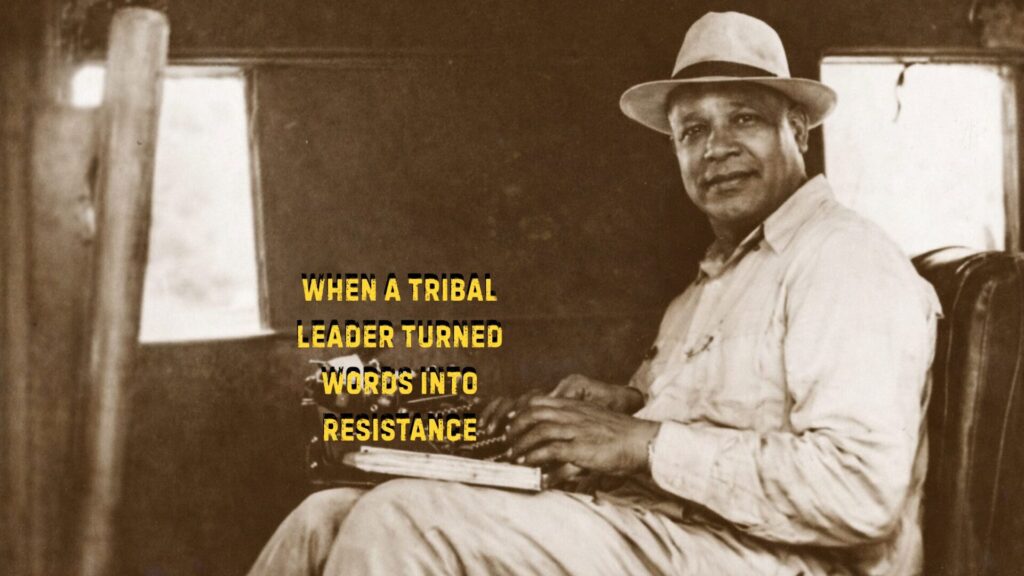
Today, we are going to talk about an extraordinary person who started life in a small tribal village and went on to become an Olympic gold medal-winning hockey captain and an important contributor to the Indian Constitution.
Jaipal Singh Munda’s life story is especially inspiring and worth highlighting today.
Birth and Tribal Roots
Jaipal Singh Munda was born on January 3, 1903, in Takara, Pahan Toli village, about 30 kilometers from Ranchi. He belonged to a Munda tribal family. At that time, the area was part of the Khunti subdivision, which later became a district. Jharkhand did not exist, and Ranchi was in Bihar province, also called Chotanagpur. His father, Amaru Pahan, was a highly respected and influential person in the village, holding a position of social authority in the tribal community.
Early Education and Exceptional Talent
Jaipal Singh Munda received his primary education at St. Paul’s Primary School, Takarani. From an early age, he demonstrated exceptional intelligence, discipline, and curiosity, quickly earning a reputation as a brilliant student. His teacher, Professor Canon Cosgrave, soon recognized Jaipal Singh Munda’s sharp intellect and distinctive personality.
One day, Professor Cosgrave observed the young Jaipal Singh Munda catching fish using traditional tribal fishing techniques. He was deeply impressed not only by the boy’s skill and deep connection with nature but also by his confidence, clarity of thought, and remarkable conversational abilities. This early recognition played a significant role in shaping the future of Jaipal Singh Munda as a tribal leader and intellectual.
Mentor Disciple Bond with Professor Cosgrave
Impressed by Jaipal Singh Munda’s abilities, Professor Cosgrave once asked him a life changing question:
“Will you walk with me to England?”
Young Jaipal eagerly said yes.
From that moment onward, a strong mentor–disciple relationship developed between Professor Cosgrave and Jaipal Singh Munda a bond that lasted a lifetime.
Mother’s Resistance and Cultural Fear
However, Jaipal Singh Munda’s mother was deeply unhappy with this growing relationship. She feared that her son would be separated from his culture, traditions, homeland, and tribal values, and absorbed into a foreign system that did not respect their way of life.
Like many tribal families of that era, she believed that Christian missionaries often overlooked tribal welfare unless religious conversion was involved. Her greatest concern was that Western education would permanently distance her son from his roots, identity, and ancestral traditions.
Childhood Name and Identity Change
An interesting fact about Jaipal Singh Munda’s life is that his childhood name was not Jaipal Singh Munda.
His original name was Pramod Pahan.
On January 3, 1911, when he was around 8–10 years old, his name was officially changed to Jaipal Singh Munda during his school years. In one of his biographies, Jaipal Singh Munda himself said:
“I don’t know who changed my name.”
Both his name and date of birth were altered when he joined St. Paul’s High School, Ranchi, where he excelled not only academically but also in sports.
Sudden Departure from Home (1918)
The year 1918 marked a major turning point in Jaipal Singh Munda’s life.
Professor Cosgrave retired and decided to take Jaipal Singh Munda with him abroad. It is said that everything happened so suddenly that Jaipal could not even meet his mother or family before leaving.
This abrupt separation deeply shaped his emotional and ideological outlook for life.
Oxford University and Higher Education
Jaipal Singh Munda went to England and pursued higher education at Oxford University, graduating from St. John’s College, Oxford.
His main subject was Economics, along with Political Science and Philosophy. He later completed his Master’s degree from Oxford University.
For a tribal boy from a remote village, studying at Oxford was nothing short of extraordinary.
Jaipal Singh Munda’s Captaincy and India’s First Olympic Hockey Gold (1928)
Jaipal Singh Munda did much more for Indian hockey than just winning medals. When India was still ruled by the British, his leadership on the hockey field stood for confidence, unity, and national pride. The 1928 Olympic Games were a big moment not just for Indian sports but also for how the world saw India.
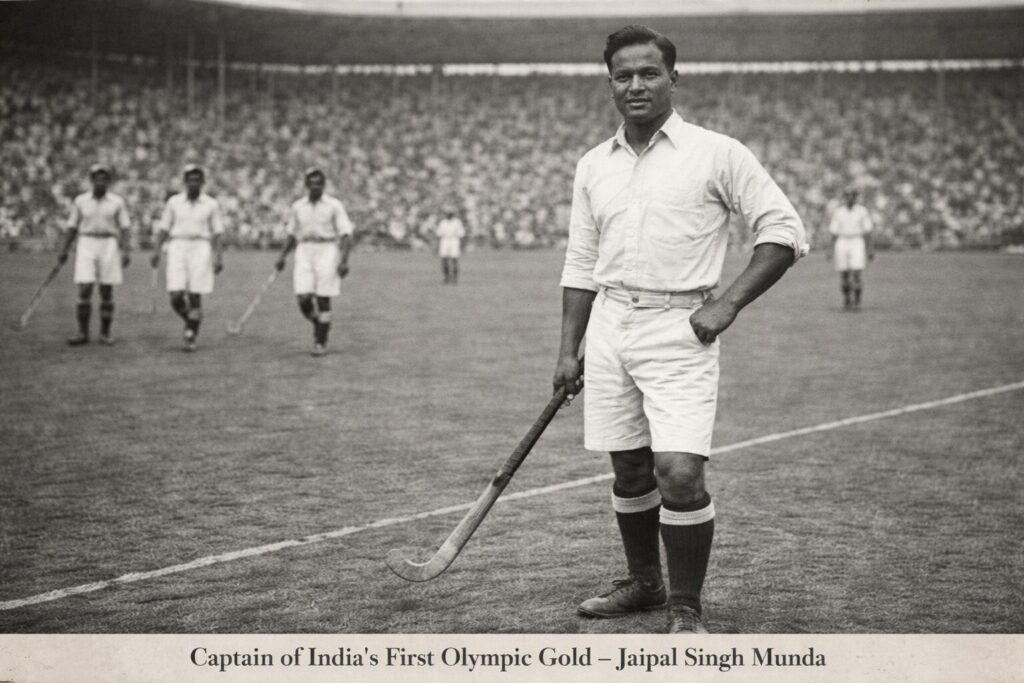
Jaipal Singh Munda as Captain of the Indian Hockey Team
At the 1928 Amsterdam Olympics, Jaipal Singh Munda led the Indian men’s hockey team with exceptional discipline and clear vision. He believed in collective strength and teamwork, ensuring that every player contributed to the team’s success. His calm leadership instilled confidence and focus on the players.
India’s Historic Olympic Gold Medal Victory in 1928
India did extremely well at the 1928 Olympics. The team did not lose any matches and conceded no goals. As a result, India won its first Olympic gold medal in field hockey, demonstrating to the world the strength of Indian hockey.
Role of Dhyan Chand and Team Unity Under Munda’s Leadership
The team included veterans like Dhyan Chand, whose goal-scoring talent played a crucial role in the tournament. However, it was the leadership of Jaipal Singh Munda that transformed individual talent into a unifying force. His ability to balance power with mutual respect made the team almost invincible.
Significance of the 1928 Olympic Gold for India
The victory had deep emotional and political significance. In an era of colonial rule, the Golden Crescent boosted national morale and reinforced the belief that Indians could compete and win at the highest international level.
A Tribal Leader Representing India on the Global Stage
Jaipal Singh Munda’s leadership was particularly meaningful to tribal communities across India. As a tribal leader who led the nation to Olympic glory, he challenged long-held stereotypes and became a source of inspiration for tribal youth. His achievement in 1928 is a powerful reminder of representation, leadership and self-respect.
Rejecting an IAS Career for Hockey and National Pride
At the peak of his sporting career, Jaipal Singh Munda was offered a prestigious position in the Indian Civil Service (ICS), the colonial-era equivalent of today’s IAS. Choosing to reject a secure and powerful administrative career, he continued to represent India on the hockey field. This decision reflects his belief that national pride and representation are more important than personal status.
A Tribal Leader on the Global Sporting Stage
Jaipal Singh Munda’s captaincy had deep symbolic meaning. As a tribal leader who led India to its first Olympic gold, he broke social barriers and challenged colonial stereotypes. His refusal to prioritise a high-level administrative career over sports and national representation further cemented his legacy as a leader driven by values rather than privilege.
Jaipal Singh Munda as a Tribal Leader and Voice of Adivasi Rights
After Olympic glory, Jaipal Singh Munda was no longer just a sports hero. He became a powerful political voice. He used his fame and influence to protect the rights of tribal communities, marking the beginning of his true legacy.
Jaipal Singh Munda emerged as a visionary tribal leader at a time when Adivasi communities were almost entirely excluded from India’s political decision-making processes. Despite attaining international recognition in sports and higher education, he made a conscious and courageous choice to dedicate his life to the cause of tribal dignity, identity, and rights. His leadership not only challenged systemic marginalization but also marked a historic turning point in the political awakening and self-assertion of India’s tribal people.
Political Awakening and Commitment to Tribal Causes
Exposure to universal ideas of democracy, equality, and self-respect profoundly shaped the political outlook of Jaipal Singh Munda. He developed a deep understanding that the most pressing challenges faced by tribal communities were the loss of land, erosion of culture, and the absence of meaningful political representation. This realization compelled him to enter public life as a determined advocate for tribal rights and interests. Rooted firmly in his Adivasi identity, his leadership was driven by a lifelong affinity and unwavering commitment to the tribal community.
Leadership of the Adivasi Mahasabha
Jaipal Singh Munda played a pivotal role in strengthening the Adivasi Mahasabha, which was formally organized under his leadership in 1938. He transformed it into a powerful platform for collective tribal assertion and political awakening. Through the Mahasabha, he strongly advocated for the protection of tribal land, forest rights, and self-governance. He consistently emphasized that Adivasis were not backward communities, but the original inhabitants of the land, possessing a distinct identity, rich culture, and deep historical legacy.
Fight for Land, Forest, and Self-Rule
When tribal lands were being systematically exploited, Jaipal Singh Munda raised his voice strongly against displacement and injustice. He firmly believed that control over land and natural resources was central to the survival and dignity of tribal communities. His advocacy laid the foundation for later movements focused on land, water, and forest rights. The struggle he began continues to be carried forward by tribal communities even today.
Representation in the Constituent Assembly of India
Jaipal Singh Munda represented tribal interests in the Indian Constituent Assembly, where he spoke boldly about the historical exploitation of tribals. He argued that political independence would be incomplete unless tribal communities received constitutional protection and equal rights in independent India.
Enduring Legacy as a Voice of Adivasi Rights
Jaipal Singh Munda’s leadership continues to inspire tribal movements across India. He was not only a political representative but also a symbol of self-respect and resistance. His life and work established him as one of the earliest and most influential voices of Adivasi rights in modern Indian history.
How Jaipal Singh Munda Became a Member of Parliament and His Tenure
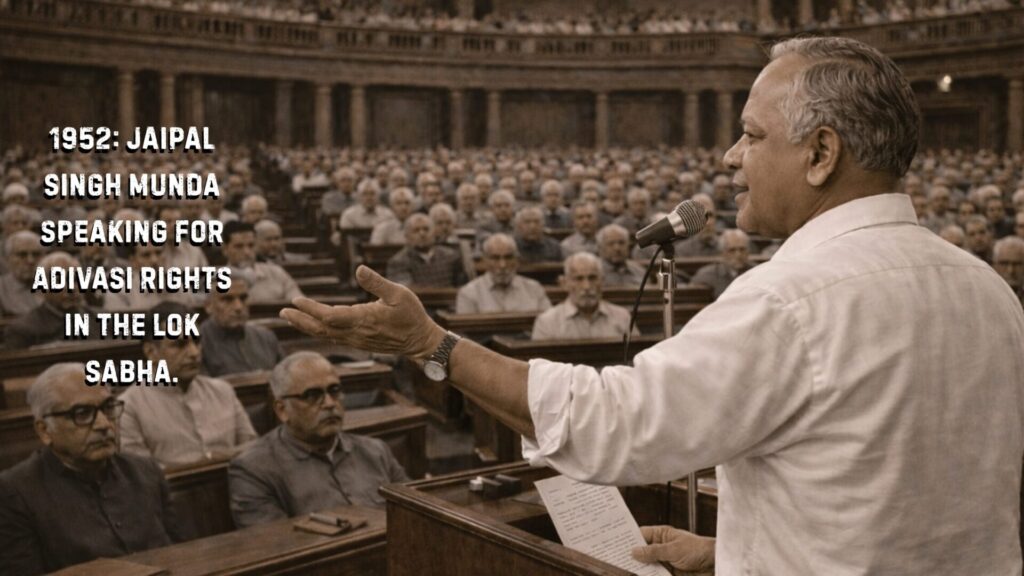
After establishing himself as a prominent tribal leader, Jaipal Singh Munda entered national politics at a crucial moment in India’s history. His rise to Parliament was not driven by personal ambition, but by the urgent need to ensure that tribal voices were represented in the newly emerging democratic framework of India.
Election to the Constituent Assembly
Jaipal Singh Munda was elected to the Constituent Assembly of India as a representative of tribal communities. This platform gave him the opportunity to directly participate in the framing of the Constitution of independent India. He consistently highlighted the historical exploitation of tribals and warned that political independence would be incomplete without justice for tribal people.
Role as a Member of Parliament
After Independence, Jaipal Singh Munda continued his political journey within India’s parliamentary system. He was elected as a Member of Parliament to the First Lok Sabha from the Ranchi (Scheduled Tribes) constituency in 1952, representing the Jharkhand Party, which he founded to safeguard Adivasi rights and demand a separate tribal state.
He served as a Member of Parliament for approximately two years (1952–1954). During this period, he used Parliament as a powerful platform to raise critical issues such as tribal land alienation, forest rights, displacement caused by development projects, and cultural marginalization. His speeches were known for their clarity, honesty, and deep emotional connection to lived tribal realities, establishing him as one of the strongest Adivasi voices in India’s early parliamentary history.
A Tribal Voice Inside India’s Power Structure
As one of the earliest tribal representatives in Parliament, Jaipal Singh Munda symbolized a historic shift in Indian politics. For the first time, indigenous concerns were being articulated from within the country’s highest decision-making institutions. After serving as a Member of Parliament for about two years, he gradually chose to step away from parliamentary life, believing that the struggle for tribal rights required stronger engagement beyond legislative spaces. He dedicated the rest of his life to fighting for tribal land, identity, and self-respect, remaining committed to the cause of Adivasi rights until his last days. His presence and choices challenged elite political narratives and reaffirmed that Adivasis were equal and rightful stakeholders in India’s future.
Why Jaipal Singh Munda Became the True Voice of Tribal Rights in India
In Indian history, B. R. Ambedkar is rightly remembered for securing constitutional rights and dignity for Dalits and other marginalized communities. His contribution to social justice through the Constitution remains unparalleled. However, when it came specifically to tribal rights, identity, and self-respect, Jaipal Singh Munda emerged as the most authoritative and authentic voice of indigenous India.
Jaipal Singh Munda never treated tribal issues as secondary political concerns. For him, tribal rights were central to the idea of justice and nationhood. He firmly rejected colonial and mainstream narratives that portrayed tribal communities as backward or primitive. Instead, he asserted that tribals were the original inhabitants of the land, with their own history, culture, and systems of self-governance that deserved respect rather than assimilation.
While he acknowledged the importance of constitutional protection, Jaipal Singh Munda believed that real justice for tribal communities could not be achieved through legal provisions alone. He fought relentlessly for the protection of tribal land, the preservation of cultural identity, and genuine autonomy in tribal regions. His struggle focused on ensuring a life of dignity, not merely legal inclusion.
Unlike many leaders who remained confined to elite political institutions, he consistently chose people over power. Even after serving in Parliament, he preferred grassroots engagement and direct connection with tribal communities, believing that meaningful change comes from standing with the people.
What truly set Jaipal Singh Munda apart was his unwavering insistence on maan aur samman—dignity and self-respect—for tribal people. While Ambedkar reshaped India’s constitutional framework for social justice, Jaipal Singh Munda became the enduring conscience and voice of tribal India, defending its rights, identity, and dignity.
Why Jaipal Singh Munda Was Called “Marang Gomke”
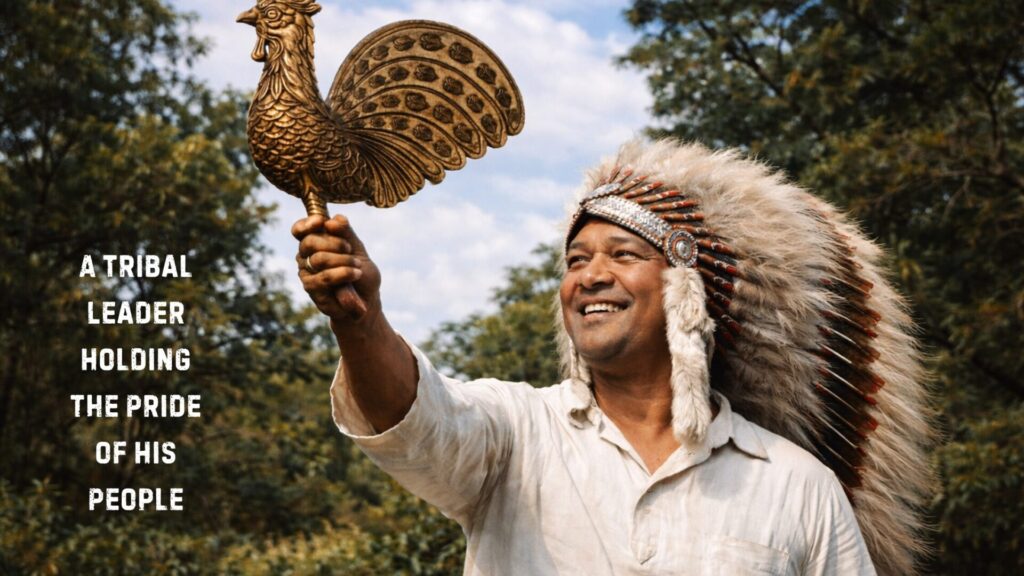
Jaipal Singh Munda was respectfully called “Marang Gomke,” a powerful title given to him by the Munda and other tribal communities. In tribal tradition, Marang means great and Gomke means leader or chief. Together, Marang Gomke signifies the “great leader of the people.” This title was not bestowed by any institution; it was earned through trust, struggle, and a lifelong commitment to tribal society.
He came to be known as Marang Gomke because he consistently stood for tribal pride, land rights, and identity at a time when tribal communities were facing displacement and marginalization. Jaipal Singh Munda openly declared that tribal people were the original inhabitants of the land and firmly rejected narratives that portrayed them as backward or inferior. His fearless presence in both national politics and grassroots movements made him a lasting symbol of resistance and self-respect.
In Parliament, Jaipal Singh Munda made one of his most powerful assertions on tribal identity:
“We accept the names Adivasi and even ‘junglee’ because they are connected to our identity and history.
But we will not accept any name that denies our existence, dignity, or self-respect.”
This statement reflected his deep belief that the right to define one’s own identity is central to freedom. For him, imposed labels that erased tribal history were unacceptable, regardless of who imposed them.
Unlike many leaders who distanced themselves after assuming power, Jaipal Singh Munda remained deeply connected to tribal communities. Even after serving in Parliament, he chose to stay close to the people and continue the struggle for their rights. His life reflected moral leadership rooted in service rather than authority based on position.
The title Marang Gomke reflects how tribal communities viewed him not merely as a politician, but as a guardian of identity and a guide for future generations. Even today, he is remembered as the conscience and enduring voice of tribal India.
The Forgotten Constitutional Battle: How Jaipal Singh Munda Defended the Very Word “Adivasi”
One of Jaipal Singh Munda’s most vital yet overlooked contributions was his principled fight in the Constituent Assembly to safeguard the identity of India’s tribal people not only through land or politics, but through language.
In 1948, during debates in the Constituent Assembly, a proposal arose to remove the term “Adivasi” from the Constitution. Many viewed this as a minor semantic change. For Jaipal Singh Munda, however, it represented an erasure of identity, history, and truth.
He strongly opposed the move, arguing that without the word Adivasi, there could be no accurate description of India’s original inhabitants. According to him, no alternative term could convey the historical, cultural, and emotional depth embedded in the word “Adivasi.” He made it clear that deleting this term would symbolically deny tribal people their status as the first inhabitants of the land.
Jaipal Singh Munda reminded the Assembly that Adivasis were not communities seeking recognition after independence; they were societies that had existed long before modern India was imagined. Removing the term, he argued, would mean rewriting history from the perspective of power, not truth.
This resistance was neither popular nor politically convenient. Yet, he stood firm, knowing that future generations of tribal people would need constitutional language that affirmed their existence, rather than diluted it.
Today, while many remember Jaipal Singh Munda as a tribal leader, sportsman, or parliamentarian, very few know that the continued constitutional presence of the word “Adivasi” is also part of his legacy a silent victory that continues to protect identity even now.
This battle over a single word reveals a larger truth:
Jaipal Singh Munda was not merely fighting for rights he was fighting for recognition, memory, and dignity itself.
FAQ
Who was Jaipal Singh Munda as a Tribal Leader?
Jaipal Singh Munda was one of India’s most influential figures, known for fighting for Adivasi land rights, identity, and self-respect. He represented tribal communities in national politics and remained committed to their rights throughout his life.
Why is Jaipal Singh Munda called the greatest tribal leader of India?
Jaipal Singh Munda is regarded as a great leader because he defended tribal dignity, opposed the exploitation of ancestral land, and asserted that Adivasis were the original inhabitants of the land. His leadership was rooted in grassroots struggle rather than political power.
What role did Jaipal Singh Munda play as a tribal leader in Parliament?
Jaipal Singh Munda raised strong voices in Parliament for tribal identity, land rights, and autonomy. He famously stated that tribals had the right to define their own identity and firmly rejected labels that denied their dignity and self-respect.
Why do tribal communities remember Jaipal Singh Munda as Marang Gomke?
Tribal communities remember Jaipal Singh Munda as Marang Gomke, meaning “great leader,” because he dedicated his life to protecting tribal rights, culture, and honor. The title reflects the trust and respect he earned from Adivasis, not from institutions.
Conclusion
Jaipal Singh Munda’s life is a powerful reminder of what true leadership means. He was not just a celebrated sportsman or a participant in national politics, but above all a tribal leader who dedicated his entire life to the cause of dignity, identity and justice for tribal communities. From the hockey field to Parliament and from international platforms to grassroots movements, he raised the voice of tribal India with courage and clarity.
As Jaipal Singh Munda, he challenged the colonial mindset, rejected imposed identities, and asserted that tribal people were equal stakeholders in the future of the nation. His refusal to compromise on land rights, cultural respect, and self-governance made him a leader trusted by the people rather than defined by power or position. The title Marang Gomke was not an honour bestowed by institutions it was a recognition earned through a lifetime of struggle and moral authority.
Even decades later, his ideas remain deeply relevant. Issues of tribal displacement, cultural erosion and land loss continue to shape India’s social reality. In this context, Jaipal Singh Munda’s vision provides guidance and inspiration for the present and future generations. He showed that real leadership lies in standing with the people, speaking truth to power and protecting identity with self-respect.
Jaipal Singh Munda’s legacy is not confined to the history books. He lives on in the ongoing struggle for tribal rights and in the collective memory of tribal communities as a conscience, a guide, and one of India’s greatest tribal leaders.
Your feedback means a lot to us.
If you have any questions, suggestions, or concerns, feel free to leave a comment below. We’re here to listen, grow, and improve together.
THANK YOU…………………………………..THANK YOU…………………………………..THANK YOU…………………………………..